Stars · Stellar Modeling
Stellar Modeling
Testing stellar evolution models against thousands of observed red giant stars.
In brief
Stars are the clocks and scales of the Universe: their ages date the history of the Milky Way, and their masses and sizes calibrate much of astronomy. But we cannot see inside a star or watch it age, so ages and masses come from models of stellar structure and evolution: computer codes that solve the equations of a star's interior (gravity, pressure, energy transport and nuclear burning) as the star ages.
The Sun has been fusing hydrogen into helium in its core for about 4.6 billion years. In about another 5 billion, its core will run out of hydrogen. The core will contract, hydrogen will keep burning in a shell around it, and the outer layers will swell: the Sun will become a red giant, cooler at the surface but far more luminous (see the figure).
Large surveys now measure thousands of red giants: their temperatures and surface chemistry from spectra, and their oscillations (see Asteroseismology). That lets us test the models of this phase in detail. Two events are especially telling.
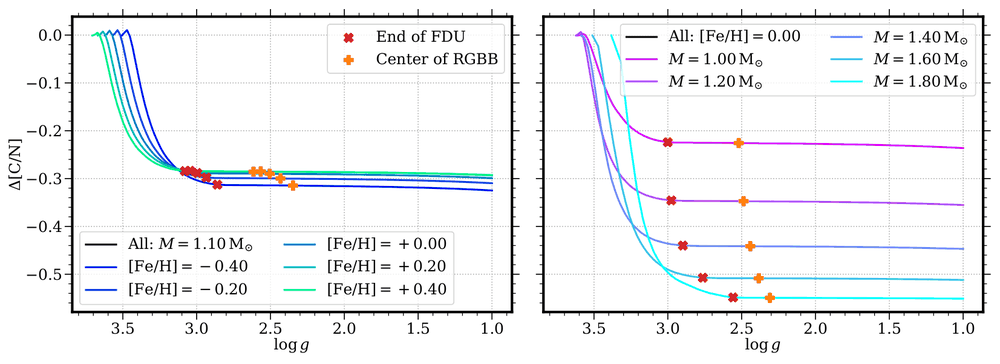
- In the first dredge-up, the star's outer layer, which is stirred by convection (hot gas rising and cool gas sinking, as in a pot of water heating on a stove), reaches deep enough to bring material processed by nuclear reactions up to the surface. The surface's chemical composition changes, and spectra can measure the change, for example in the ratio of carbon to nitrogen.
- Later, the hydrogen-burning shell moves outward and reaches the depth where that convective layer once reached deepest, which left a sudden change in composition. There the shell suddenly meets more hydrogen-rich fuel, and the star briefly dims before brightening again. Because each star passes through that brightness three times (up, down, then up again), more stars are found there: the red giant branch bump.
Models predict where each event happens, so comparing them with observations tests the physics deep inside stars. My work does that comparison for thousands of red giants (below).
New to this topic? The Glossary explains the terms in plain language; underlined terms link to it.
What I have done
We compared stellar models computed with MESA against APOKASC-3, a joint spectroscopic and asteroseismic catalog of red giants in the Kepler fields (Cao and Pinsonneault 2026; code, MESA inlists). Both features are offset from the models, although the [C/N] offset is within the systematic uncertainties of the abundance measurements. The observed change in [C/N] at the first dredge-up is smaller than predicted, by about 0.16 dex, and the observed bump sits about 0.15 dex higher in surface gravity than predicted. A proposed fix for the bump, envelope undershooting, would also destroy more lithium during the first dredge-up at higher metallicities, in tension with what GALAH observes, so we used lithium to challenge that fix, and we propose lithium as a sensitive test of both features.
Building on my experience with MESA, I have also helped maintain and modernize the Yale Rotating Evolution Code (YREC), as a coauthor of its public data release.
Papers
First-author papers
- Modeling APOKASC-3 red giants: I. The first dredge-up and red giant branch bump
· DOI · arXiv:2501.14867 · ADS · Code · Zenodo · Talks and posters: AstroCoffee, Pittsburgh, 2025, first results, 2022
Coauthored papers
- The YREC Stellar Evolution Code: Public Data Release
· DOI · arXiv:2603.25792 · ADS · Code
I took part in maintaining and modernizing the YREC code and in related discussions, and commented on the manuscript.
What comes next
Next come two follow-up papers, on mass loss along the red giant branch and on the α-enhancement of stars' birth composition, and a proposed overhaul of YREC, with an object-oriented framework, hooks for user-defined physics and possibly a Python interface.
How this fits into my next five years: Research Directions.
Terms on this page (11)
- Stellar model
- A computer solution of the equations of a star's structure (gravity, pressure, energy transport and nuclear burning) followed over time. Codes such as MESA and YREC compute them.
- Red giant, red giant branch
- A star that has run out of hydrogen in its core and swollen to many times its former size (up to a hundred times or more), with a cool, red surface. The red giant branch is the path such stars follow in the Hertzsprung–Russell diagram as they grow brighter.
- First dredge-up
- The stage, early on the red giant branch, when the star's convective outer layer reaches deep enough to bring material processed by nuclear burning up to the surface, changing its measured composition.
- Convection
- Energy transport by the motion of gas: hot gas rises and cool gas sinks, as in a pot of water heating on a stove. The outer layers of red giants are convective.
- Red giant branch bump
- A pile-up of red giants at one brightness. It is caused by a brief dimming when the hydrogen-burning shell reaches the sudden change in composition left where the convective layer once reached deepest; each star passes that brightness three times. Its position tests how deep convection mixes.
- Hertzsprung–Russell diagram
- A plot of stars' luminosity against their surface temperature, with hotter stars on the left. Stars at different stages of life fall in different regions, so a star's evolution traces a path across it.
- Main sequence
- The long, stable stage of a star's life, when it burns hydrogen in its core; about 90% of a star's life is spent there. The Sun is on the main sequence.
- [C/N]
- The ratio of carbon to nitrogen at a star's surface, compared with the Sun's, on a logarithmic scale: [C/N] = −0.2 means the ratio is 10−0.2 ≈ 0.63 times the Sun's. The first dredge-up lowers it, so it measures how deep mixing reached.
- dex
- A difference of 1 in a base-10 logarithm, that is, a factor of 10. So 0.15 dex is a factor of about 1.4.
- Surface gravity (log g)
- The gravitational acceleration at a star's surface, g = GM/R². Astronomers quote log g, the base-10 logarithm of g in cm/s². The Sun's is 4.44 (about 27,000 cm/s², 28 times Earth's); most observed red giants' are about 1 to 3.5.
- Metallicity
- The fraction of a star's material made of elements heavier than helium (all "metals" to an astronomer), usually given relative to the Sun on a logarithmic scale.