Images · Image Analysis
Image Analysis
The physical meaning of astronomical images: noise, detector effects and systematics, and images as discrete samples of continuous fields.
In brief
Every astronomical image mixes signal with imperfections. The detector adds noise, some pixels misbehave, and the processing leaves its own traces. To measure something tiny, such as the 1% stretch of weak gravitational lensing, you first have to understand these imperfections well enough to model them or remove them.
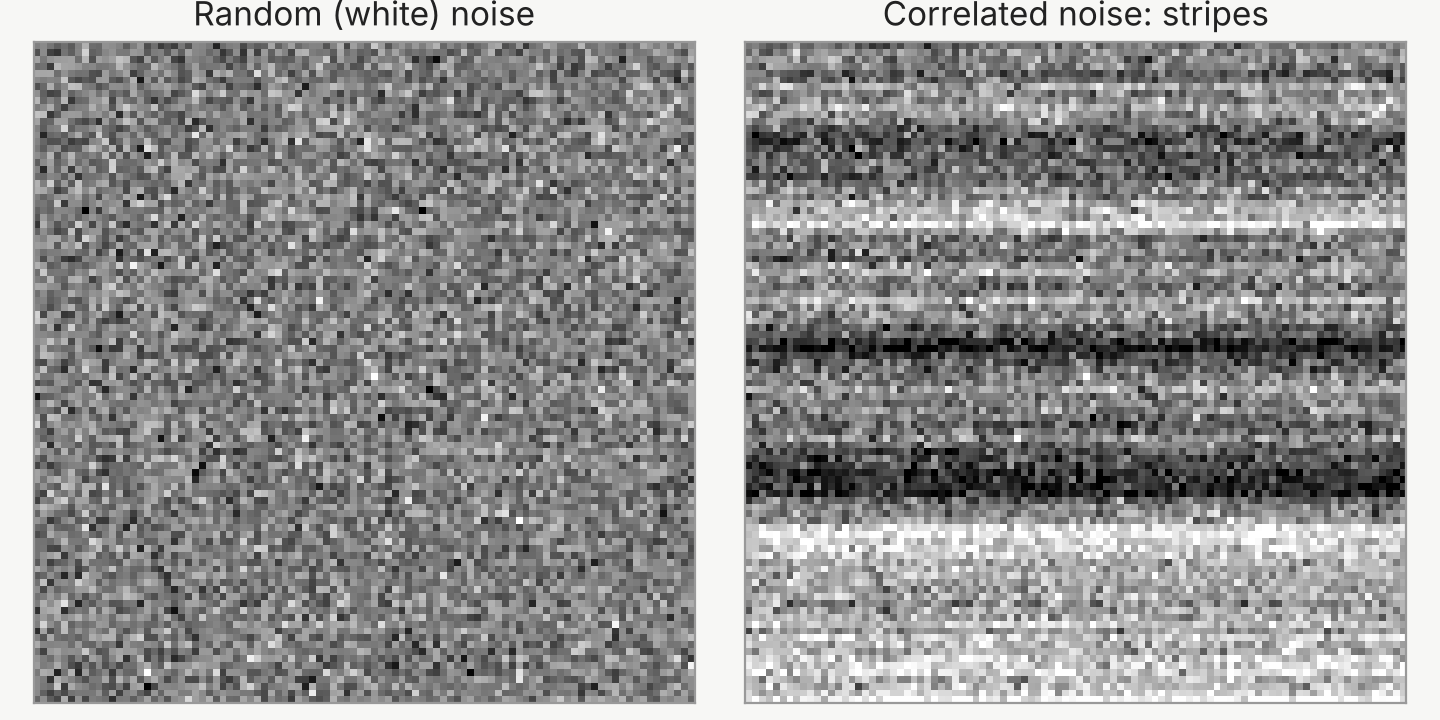
One example comes from Roman's infrared detectors. Their pixels are read out one after another, so the pixels in a row are read within a short time. Slow drifts in the readout electronics then shift a whole row up or down together, leaving faint horizontal stripes. This is correlated noise: unlike random noise (called white noise), it is shared by neighboring pixels, so combining pixels does not beat it down nearly as well (see the figure). Left uncorrected, the stripes give the image a preferred direction, which can bias the measured shapes of galaxies. Errors that push results in a consistent direction are called systematics; taking more data does not make them go away, so they must be modeled or removed.
A deeper question runs through this work: what does a pixel value actually mean? It is best thought of not as a little square of sky, but as a sample, at one point, of the sky's brightness after it has been blurred by the telescope and by the way the pixel collects light across its area. Treating images as discrete samples of continuous brightness maps is the starting point of my ideas on this topic. So far, I have contributed to team studies of noise in Roman images and of tools that remove it (below).
New to this topic? The Glossary explains the terms in plain language; underlined terms link to it.
What I have done
My work here so far is in team studies of noise and systematics in simulated Roman images, to which I have contributed: how noise biases weak lensing measurements; how to remove correlated noise stripes, whose power on large scales the team's imDestripe reduces by factors of 10 to 30; and how to make photometry robust using both Roman and Rubin images, where ignoring correlated noise underestimates photometric uncertainties by up to about three times. My contribution has mainly been PyIMCOM, the platform for several of these studies, and my expertise in IMCOM.
My interest in image analysis grew out of my work on image reconstruction. Developing Effortless made me think hard about the physical meaning of astronomical images, and about the relationship between discrete samples and continuous fields.
Papers
Coauthored papers
- Robust Photometry for Roman High-Latitude Imaging Survey Cosmology Using Roman and Rubin Imaging
· arXiv:2607.09849 · ADS
I contributed my expertise in IMCOM. - Removing correlated noise stripes from the Nancy Grace Roman Space Telescope survey images
· DOI · arXiv:2512.05949 · ADS · Code
I led the development of the PyIMCOM software, the platform for this work, and commented on the manuscript. - OpenUniverse2024: A shared, simulated view of the sky for the next generation of cosmological surveys
· DOI · arXiv:2501.05632 · ADS
I led the development of the PyIMCOM software used to produce the IMCOM coadds, and contributed to writing the paper. - Analysis of biasing from noise from the Nancy Grace Roman Space Telescope: implications for weak lensing
· DOI · arXiv:2410.11088 · ADS
I led the development of the PyIMCOM software used to combine the images, took part in discussions of the data analysis methods, and commented on the manuscript.
What comes next
Fetterless: new tools for analyzing and generating images as discrete samples of continuous fields. The idea is still at an early stage.
How this fits into my next five years: Research Directions.
Terms on this page (8)
- Noise
- Random fluctuations in a measurement that are not part of the signal, for example from the random arrival of photons or from the detector's electronics.
- Weak gravitational lensing
- The slight bending of light from distant galaxies by the gravity of matter in front of them, which stretches their images by about 1%. Averaged over millions of galaxies, it maps all the matter, including dark matter, and so tests cosmological models.
- Noise that is shared by neighboring pixels instead of varying independently from pixel to pixel; for example, stripes that make a whole row slightly brighter or darker. Unlike white noise, it is not beaten down efficiently by combining neighboring pixels, and if uncorrected it can mimic real patterns.
- White noise
- Noise that varies independently from one pixel (or moment) to the next, with equal strength on all scales, by analogy with white light, which mixes all colors equally. Averaging N pixels of white noise reduces it by a factor of √N.
- Systematics, systematic errors
- Errors that push results in a consistent direction, instead of scattering them randomly. More data do not average them away, so they must be understood and corrected. Uncorrected noise patterns, such as stripes, can become systematics when they mimic the signal.
- Sampling
- Recording a continuous quantity at discrete points; a camera samples the sky's brightness at each pixel. See also Nyquist–Shannon sampling theorem.
- Photometry
- Measuring how bright an object is, often through several color filters. Brightness in different filters gives information about color, and so about temperature or redshift.
- IMCOM
- Short for IMage COMbination: an image-combination method that chooses the weights of input pixels so that the output image has a PSF as close as possible to a target the user specifies, while keeping the noise under control. PyIMCOM is its modern implementation for Roman, and Effortless is a faster successor.